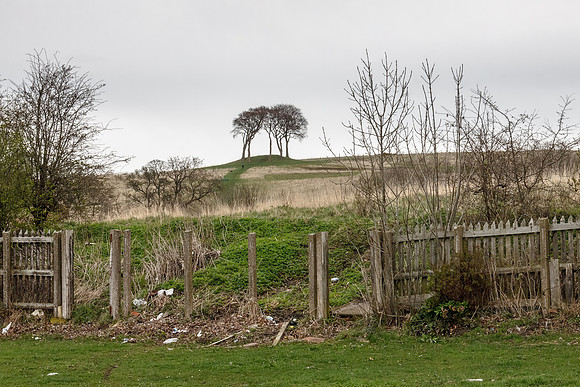
Copt Hill III
Copt Hill is probably the best known prehistoric site in the Sunderland area. A prominent and unique landscape feature it has attracted much interest. As a result it is a protected area being both a council protected Nature Reserve and an English Heritage ancient monument. The mound was excavated initially by Canon Greenwell and Thomas Robinson in 1877 when numerous cremated and disarticulated bodies were found presumably burnt in-situ and thought to be a type of ‘flue cremation’. This is now disputed and the ‘flues’ are thought to be simply the remains of the mortuary structure. Further excavations were performed in 2003 and 2004 and these recovered finds that dated the use of the site to the late Mesolithic period (6-7000 years ago), making it older than Stonehenge.
The site of the barrow offers spectacular views over the area and like the Tunstall Hills, it is also important to the local wildlife. These properties make it a popular and well known local landmark which has attracted the attention of preservation societies and groups.